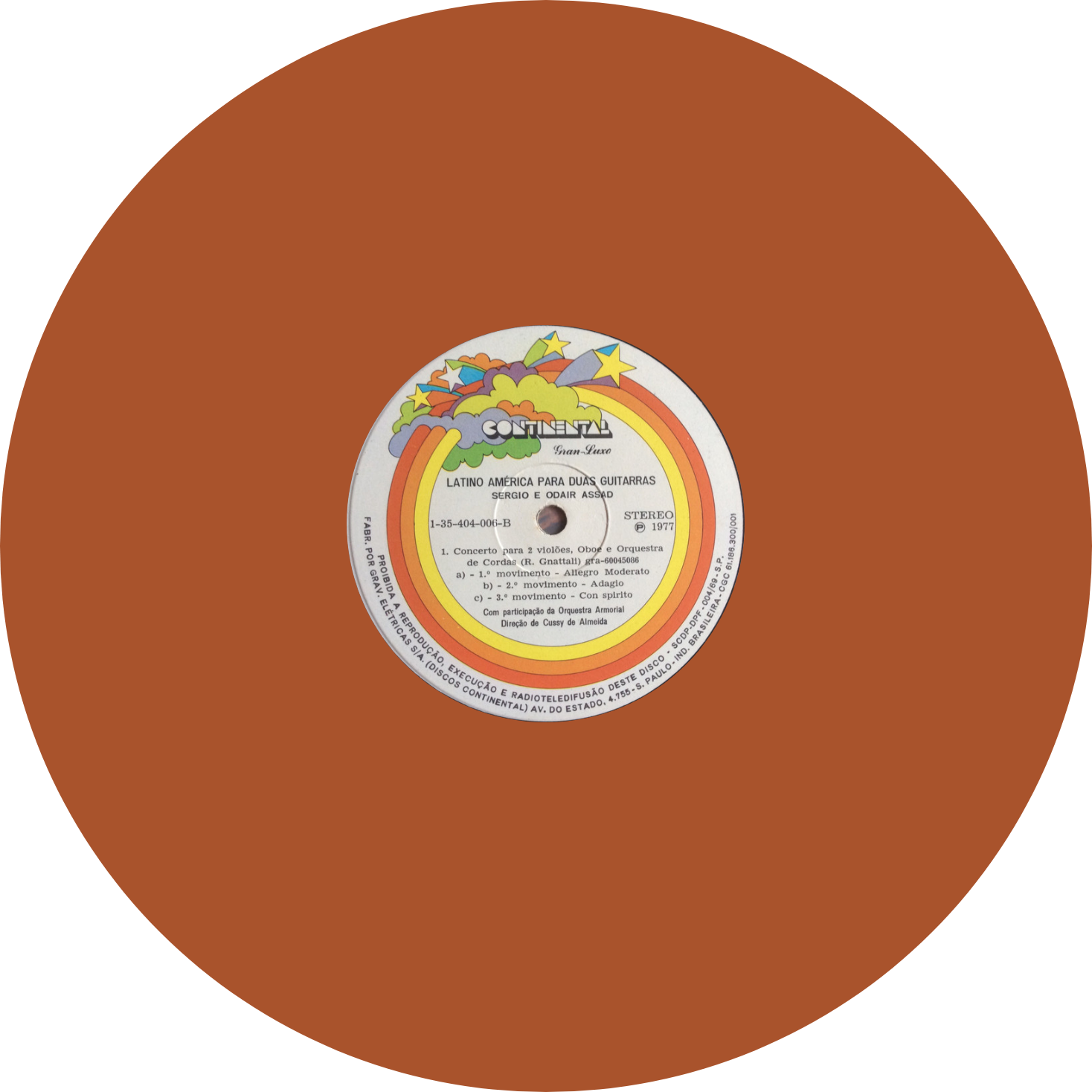
In 1976, the opportunity to record their first album arose. Initially, the project envisioned one side featuring the Armorial Orchestra of Recife, conducted by Cussy de Almeida, performing Radamés Gnattali’s “Concerto for Two Guitars, Oboe, and String Orchestra,” and the other side featuring an adaptation of Vivaldi’s “Concerto for Two Mandolins and Strings.” But in the middle of the sessions, an unforeseen event occurred: Odair suffered a deep cut on his right thumb while opening a can of chestnuts. Though he wanted to continue, the recording had to be postponed for two months and ultimately took place in Rio de Janeiro.
With the orchestra no longer involved, the repertoire had to be reprogrammed and came to include works already in the duo’s repertory: the second movement of Mario Castelnuovo Tedesco’s “Sonatina Canonica – Tempo di Siciliana” and Francisco Mignone’s “Lundu”—both original pieces for guitar duo. The album, titled Latino América para Duas Guitarras, became the first of many in the Duo 's career.
Two years later, they released their second album, “Heitor Villa-Lobos: Obra Completa para Violão Solo”, in which each performed Villa-Lobos’s pieces individually.
Simultaneously with these early releases, new opportunities began to appear. TV Globo—airing the musical series Concertos para a Juventude—invited them to perform. Hosted by conductor and composer Marlos Nobre and broadcast on Sundays, the program aimed to popularize classical music in Brazil, featuring the Brazilian Symphony Orchestra and guest artists. Deeply moved by the brothers, the maestro himself nominated them in 1979 to represent Brazil at the UNESCO-organized Young Performers Tribune in Bratislava, then in Czechoslovakia. Among the participants were pianists, flutists, and cellists. But Sérgio and Odair, the only guitarists, stood out for their singularity and won first place.